For decades, robots have been exceptionally good at doing what they were told—and remarkably bad at dealing with anything they were not.
That may finally be changing.
The latest wave of robotics is not simply about building machines with stronger motors, better cameras or more precise mechanical arms. It is about giving machines something much closer to intelligence: the ability to perceive their surroundings, understand instructions, reason about unfamiliar situations and act in the physical world.
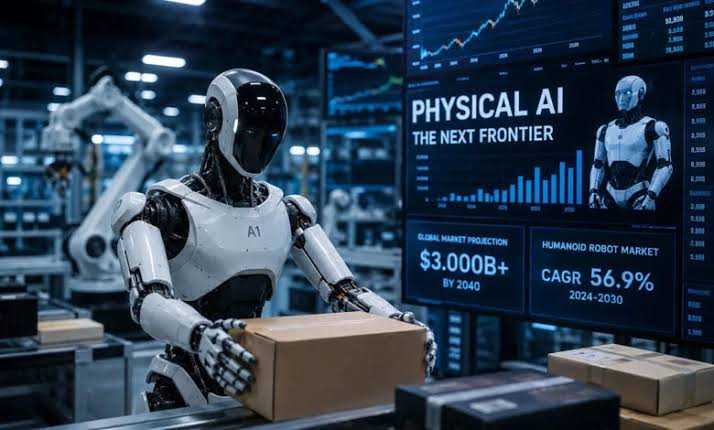
This emerging field is increasingly being described as physical AI or embodied AI. And unlike many futuristic technologies that remain trapped in demonstrations and research labs, physical AI is beginning to move into factories, warehouses, logistics networks and other real-world environments.
The fascinating part is that the next robotics revolution may not be about robots looking human.
It may be about robots finally thinking before they move.
From Programmed Machines to Intelligent Systems
Traditional industrial robots are highly capable, but they typically operate within carefully controlled environments. Give a robotic arm the same object, the same position and the same instructions thousands of times, and it can perform with extraordinary consistency.
But change the environment, move the object or introduce something unexpected, and the system can quickly run into problems.
Physical AI attempts to break that limitation.
Instead of programming every possible movement, developers are increasingly training AI systems to understand relationships between vision, language, movement and the physical environment. The goal is to create machines capable of adapting rather than simply repeating.
Google DeepMind, for example, has developed Gemini Robotics models designed to allow robots to perceive, reason, use tools and interact with people and their surroundings.
That represents a fundamental shift.
A robot that can understand “pick up the box and place it on the shelf” is fundamentally different from one that has been programmed with thousands of precise coordinates telling it exactly where to move its arm.
The former can potentially learn.
And learning is where robotics becomes much more interesting.
The Physical World Is the Next AI Frontier
The first major AI boom happened largely inside computers.
AI learned to generate text, create images, write software, analyze information and interact with users through screens. But the physical world remained stubbornly complicated.
Reality does not behave like a spreadsheet.
Objects can move unexpectedly. Floors can be slippery. Lighting changes. People walk into the robot’s path. A box may be heavier than expected. A simple task can require dozens of subtle decisions.
This is precisely why physical AI is so difficult—and potentially so valuable.
A successful physical AI system must connect perception with action. It needs to understand what it sees, predict what might happen next and choose an appropriate response in real time.
That is an enormous technological challenge.
But progress is becoming difficult to ignore.
At the 2026 World Humanoid Robot Games in Beijing, humanoid machines competed across dozens of events involving mobility, coordination and practical manipulation. One Chinese humanoid, Tiangong Ultra, even recorded an 8.64-second 100-meter run, faster than Usain Bolt’s 9.58-second human world record. Yet the demonstration also exposed the gap that remains: the robot struggled with deceleration and obstacle avoidance, showing that raw physical performance is only one piece of the puzzle.
That distinction matters.
The future of robotics will not be decided by which machine can run fastest.
It will be decided by which machine can understand what to do next.
Why Humanoid Robots Are Getting So Much Attention
There is a reason humanoid robots have become one of the most closely watched areas of technology.
Human environments were designed for humans.
Factories contain human-sized workstations. Warehouses use stairs, shelves and doors. Homes contain kitchens, furniture and appliances built around the human body.
A humanoid robot could theoretically operate within those environments without requiring everything around it to be redesigned.
That does not necessarily mean humanoids will dominate robotics. In many industrial applications, specialized machines remain faster, cheaper and more efficient. China’s industrial robotics industry, for instance, continues to demonstrate the strength of purpose-built automation rather than relying exclusively on humanoid machines.
But general-purpose robots offer something specialized machines often cannot: flexibility.
Instead of purchasing one machine for one task, companies could eventually deploy robots capable of learning several different tasks.
That possibility is what has attracted enormous attention from technology companies, manufacturers and investors.
The Race Is Moving From Hardware to Robot Brains
For years, robotics was primarily a hardware competition.
Who could build the strongest actuator? The lightest frame? The most precise robotic arm?
Now another layer is becoming just as important: the robot brain.
NVIDIA has been pushing aggressively into this emerging market, building computing platforms, simulation systems and AI models designed specifically for physical AI. In March 2026, the company announced partnerships across the robotics ecosystem aimed at bringing physical AI into production-scale applications.
This approach highlights an important reality: building capable robots is not simply a matter of attaching a powerful AI model to a machine.
Robots need training environments.
They need simulations.
They need enormous amounts of physical-world data.
They need fast computing at the edge.
And, perhaps most importantly, they need safety systems capable of preventing an intelligent machine from making dangerous decisions.
NVIDIA’s 2026 introduction of its Halos robotics safety system reflects how seriously the industry is beginning to treat that challenge.
The smarter robots become, the more important it becomes to ensure that intelligence remains predictable.
Manufacturing Could Be the First Major Breakthrough
The home robot remains one of the most exciting visions of the future, but factories may be where physical AI proves itself first.
Manufacturing environments are structured, repetitive and economically sensitive to efficiency. That makes them ideal testing grounds for increasingly autonomous machines.
BMW, for example, has been advancing the use of physical AI through work involving Figure humanoid robots at its Spartanburg manufacturing facility.
Other industries are also exploring the technology for logistics, inspection, warehousing and industrial operations.
This could create a powerful feedback loop.
More robots generate more real-world data.
More data improves AI models.
Better models make robots more capable.
More capable robots create more commercial demand.
And greater demand accelerates investment.
That is how a technology moves from demonstration to infrastructure.
The Biggest Question Is Not Whether Robots Will Arrive
It is how quickly they will become useful.
There is still a considerable distance between a robot completing a controlled demonstration and a machine reliably working eight hours a day in an unpredictable environment.
Dexterity remains difficult. Battery life matters. Hardware costs remain high. Training data is limited. Safety requirements are enormous. And the physical world is full of edge cases that AI systems cannot simply predict from internet-scale data.
There is also the economic question.
If robots become capable enough to perform a growing number of physical jobs, businesses may become dramatically more productive. But the transition could also reshape employment, wages and the skills demanded from workers.
The technology therefore presents both an opportunity and a disruption.
And perhaps that is what makes physical AI so important.
The Robot Revolution May Be Quieter Than Expected
The biggest robotics breakthrough may not arrive as a dramatic moment when a humanoid robot walks into someone’s living room.
It may happen gradually.
A robot sorting components in a factory.
An autonomous machine inspecting infrastructure.
A warehouse system that can adapt when inventory moves.
A robot learning a new task from a simple instruction.
Eventually, these systems could become so ordinary that people stop thinking of them as robots at all.
That is the real promise of physical AI.
AI has already learned how to work with information. The next challenge is learning how to work with reality.
And once machines can reliably see, reason and act within that reality, the boundary between the digital world and the physical one could begin to disappear.
The age of physical AI is not fully here yet.
But for the first time, it is becoming increasingly difficult to argue that it is still science fiction.