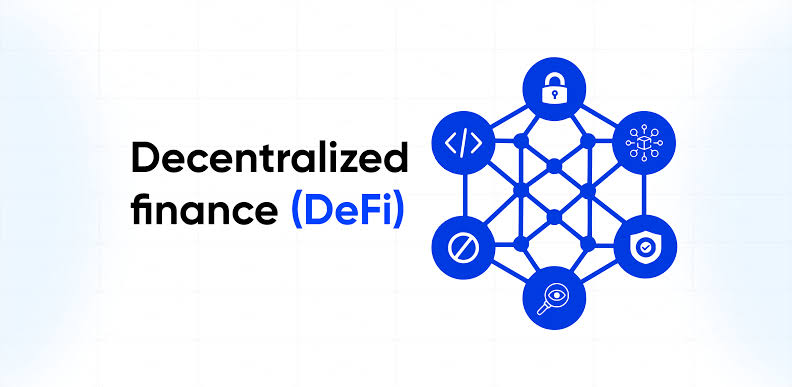
For a market that spent years being written off as too complicated, too risky, or too speculative, decentralized finance is sending a different message in 2026.
Capital is moving back on-chain.
The return is not necessarily arriving as the explosive, speculation-driven frenzy that defined earlier DeFi cycles. Instead, activity is appearing across decentralized exchanges, lending protocols, stablecoin markets and tokenized assets. That distinction could prove important.
DeFi may not be returning to repeat its previous boom.
It may be evolving into something considerably more mature.
Recent market data has highlighted renewed activity across decentralized financial platforms, with DEX volumes, stablecoin liquidity and lending markets becoming increasingly important parts of the broader digital-asset ecosystem. At the same time, institutional participation and tokenization are creating new pathways for capital to enter blockchain-based financial markets.
The big question is no longer whether DeFi can attract users.
It is whether this new wave of activity can turn into sustainable financial infrastructure.
Capital Is Moving Differently This Time
During previous DeFi booms, yield was the headline.
Investors chased double-digit returns, liquidity-mining incentives and newly launched tokens. Protocols competed aggressively for deposits, and users often moved capital from one platform to another in search of the highest possible yield.
That model generated enormous activity.
It also exposed the weaknesses of an immature market.
Today, the conversation is changing.
Users are increasingly looking for deeper liquidity, reliable lending markets, efficient trading, stablecoin utility and products that solve actual financial problems.
That may sound less exciting than a token promising extraordinary returns.
But it could be far more important.
A financial ecosystem does not become durable because users can earn high yields for a few months.
It becomes durable when users continue using it because they need it.
And that is precisely where DeFi appears to be heading.
Decentralized Exchanges Are At the Center
One of the clearest signs of renewed DeFi activity is the continued importance of decentralized exchanges.
DEXs allow users to trade digital assets directly from their wallets without handing custody of funds to a centralized exchange.
That model has obvious advantages.
Users retain control of their assets.
Trades can occur transparently on public blockchains.
And liquidity can be accessed through automated market-making systems rather than traditional order books alone.
Recent activity across decentralized trading platforms suggests that users continue to embrace this model, particularly as blockchain networks become faster and transaction costs become more competitive.
The significance goes beyond trading volume.
Every DEX transaction contributes to a larger on-chain economy involving liquidity providers, stablecoins, lending protocols, bridges and blockchain infrastructure.
When DEX activity rises, the effects can spread throughout the entire DeFi ecosystem.
Stablecoins Could Be the Real Engine
There is another piece of the puzzle that may be even more important: stablecoins.
Stablecoins provide something DeFi desperately needs—a relatively stable unit of account.
Bitcoin and other cryptocurrencies can move dramatically within hours.
That makes them powerful investment assets but less convenient for everyday financial activity.
Stablecoins solve part of that problem.
Users can move dollar-linked digital assets across blockchains, trade them on DEXs, deposit them into lending protocols and use them as collateral.
As stablecoin supply and usage expand, they create a larger pool of capital capable of moving through decentralized financial applications.
This is why the stablecoin market deserves as much attention as DeFi tokens themselves.
The next major DeFi expansion may not be driven by speculative tokens.
It may be driven by stable digital dollars quietly moving through the infrastructure.
Lending Is Becoming More Important
DeFi lending is another area attracting attention.
The concept is relatively straightforward.
Users can deposit digital assets into a protocol and potentially earn interest.
Other users can borrow against collateral without going through a traditional bank.
This removes several layers of the conventional lending process.
But the real innovation is not simply eliminating banks.
It is making lending markets programmable.
Interest rates can respond to supply and demand.
Collateral can be monitored on-chain.
Transactions can be executed through smart contracts.
And the rules of the system can be visible to anyone.
Protocols such as Aave have become important examples of this model, demonstrating how decentralized lending can operate at meaningful scale.
The growth of these markets suggests that DeFi is gradually moving beyond experimentation.
The Institutional Question
Perhaps the most important development is the increasing overlap between DeFi and traditional finance.
For years, the two worlds largely operated separately.
Banks had their financial infrastructure.
Crypto had its decentralized protocols.
Now those boundaries are becoming less obvious.
Tokenized Treasury products, real-world assets and blockchain-based settlement systems are creating new connections between traditional financial markets and decentralized infrastructure.
That could dramatically increase the potential addressable market for DeFi.
Imagine a world where a tokenized financial asset can be issued, traded, used as collateral and settled on a blockchain.
Suddenly, DeFi is no longer simply a crypto-native playground.
It becomes part of the infrastructure supporting a broader digital financial system.
That could be the industry’s most important evolution yet.
The Rise of Real-World Assets
Real-world assets, often referred to as RWAs, are becoming one of the most closely watched areas of blockchain finance.
The concept is simple but powerful.
Traditional assets—such as government securities, credit instruments or other financial products—can be represented digitally on blockchain networks.
Once tokenized, those assets can potentially interact with decentralized applications.
This creates an intriguing bridge.
Traditional finance provides the assets.
Blockchain provides the infrastructure.
DeFi provides the financial applications.
The combination could unlock markets that were previously difficult to access or settle efficiently.
It also gives DeFi something it has sometimes lacked: economic activity connected to assets outside the crypto ecosystem.
DeFi Is Becoming More Accessible
Another reason activity could continue growing is that using DeFi is becoming easier.
Early decentralized applications were not designed for beginners.
Users had to manage private wallets, understand gas fees, navigate complex interfaces and accept considerable technical complexity.
That barrier is gradually declining.
Wallets are becoming easier to use.
Blockchain transactions are becoming faster.
Layer-2 networks are reducing costs.
Interfaces are becoming more familiar.
And developers are increasingly focused on hiding unnecessary blockchain complexity from users.
That could be critical.
The next million DeFi users may not care that they are interacting with a smart contract.
They may simply want to swap an asset, earn interest, borrow funds or move money.
The technology succeeds when the technology becomes invisible.
But Risks Have Not Disappeared
A resurgence in DeFi activity does not mean the sector is suddenly safe.
Smart-contract vulnerabilities remain a major concern.
Oracle failures can create catastrophic consequences.
Liquidity can disappear during periods of extreme volatility.
Stablecoins can face their own risks.
And bridges connecting different blockchain networks remain attractive targets for attackers.
The industry’s history provides enough examples to make caution essential.
More capital also means greater incentives for malicious actors.
As DeFi grows, security cannot remain an afterthought.
It has to become part of the infrastructure itself.
Regulation Could Shape the Next Chapter
Regulation is another major variable.
Authorities around the world are increasingly focused on stablecoins, decentralized exchanges, tokenized assets and blockchain-based financial services.
Clearer rules could help institutional investors participate more confidently.
But poorly designed regulations could push innovation toward jurisdictions with fewer restrictions.
The challenge will be finding a balance.
DeFi was originally built around the idea of removing intermediaries.
The next generation may need to find ways to operate within increasingly regulated financial environments without losing the transparency and efficiency that made decentralized systems attractive in the first place.
The Search for Sustainable Yield
Perhaps the biggest philosophical shift in DeFi is the move away from artificial yield.
Earlier cycles often relied on token incentives to attract liquidity.
That could generate impressive returns temporarily.
But once incentives disappeared, users frequently left.
The newer model is different.
Protocols increasingly need revenue.
Users want sustainable returns.
Liquidity needs genuine demand.
And financial activity needs to generate economic value.
That transition may be less spectacular.
But it is healthier.
DeFi does not need to promise 100% annual returns if it can become useful enough that people want to use it without extraordinary incentives.
AI Could Add Another Layer
Artificial intelligence could also play an increasingly important role.
Imagine an AI system monitoring dozens of lending markets, comparing yields, evaluating collateral risks and executing transactions based on predefined conditions.
Instead of manually navigating several DeFi applications, users could interact with a single intelligent interface.
This could make decentralized finance dramatically more accessible.
But it also introduces new risks.
Users would need to understand how automated systems make decisions, how smart contracts execute those decisions and what happens when markets behave unexpectedly.
The intersection of AI and DeFi could therefore become one of the industry’s most fascinating—and complicated—next frontiers.
What Comes Next?
The current revival is still developing.
There is no guarantee that increased activity will become a sustained bull market.
Crypto markets remain highly sensitive to interest rates, liquidity, regulation and investor sentiment.
A sharp macroeconomic downturn could quickly reduce risk appetite.
A major protocol exploit could damage confidence.
And a prolonged period of tight financial conditions could pull capital away from decentralized markets.
But the underlying trend is difficult to ignore.
DeFi has survived multiple cycles.
It has lost billions in speculative capital.
It has endured hacks, collapses and regulatory uncertainty.
And yet the infrastructure continues to evolve.
That resilience may be its most important characteristic.
The Bigger Picture
The return of capital to decentralized markets is not necessarily about another speculative DeFi summer.
It could represent something much more significant.
DEXs are becoming more efficient.
Lending markets are becoming deeper.
Stablecoins are becoming more widely used.
Tokenized assets are connecting traditional finance with blockchain networks.
And developers are working to make decentralized applications easier to use.
Piece by piece, the industry is building something that looks less like an experiment and more like financial infrastructure.
That does not mean DeFi will replace traditional finance.
The more likely outcome is convergence.
Traditional institutions may increasingly use blockchain infrastructure.
Crypto-native protocols may adopt more sophisticated compliance and risk systems.
And users may eventually stop caring whether a financial service is technically “centralized” or “decentralized.”
They will care whether it is fast, transparent, affordable and reliable.
The Final Takeaway
DeFi appears to be entering another important chapter.
The difference this time is that the market is not being driven solely by hype.
Capital is increasingly flowing toward systems that provide tangible financial functions—trading, lending, payments, collateralization and access to tokenized assets.
That makes the current resurgence particularly intriguing.
The next DeFi boom may not arrive with explosive token launches and unsustainable yields.
It may emerge quietly through increasing transaction volumes, deeper liquidity, growing stablecoin usage and greater integration with traditional finance.
And that could make it much harder to see—and potentially much more important.
Because the most significant DeFi revolution may not be the one that creates the loudest headlines.
It could be the one that quietly turns blockchain-based finance into something people simply use every day.
